Diffuse emissions, PM, and industry 4.0: a wry look at development of SOTA 2019-2026
In this post I provide a BTS perspective on development of SOTA for PM measurements 2019-2026, based on experiences from a number of R&D projects. This is done on the backdrop of the 2023 report by NEA and Norce about "Monitoring of diffuse emissions to air from industry".
The scene: Stylish lunch party on May 17, the Norwegian national day. Women and men in their sixties in formal outfits. Champagne in the flutes. Easy-flowing conversations, good mood, the occasional joke. Plus, two grey-haired engineers (from the looks) discussing PM (Particulate Matter), first as part of the general conversation, then less so (the Dave Berry quote about receiving invitations to dinner parties comes to mind). I was one of the engineers, the other guy we will call Petter. Petter concluded with the following quip: "Meeting someone at a formal lunch party wanting to discuss sensor technology and mitigating measures for particulate matter and diffuse emissions in heavy industry is a personal first." Probably true.
Background, methodology, and disclaimers
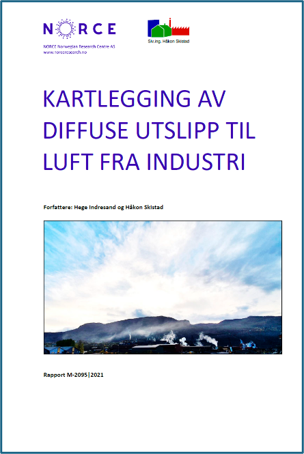
In this blog post I will follow up my conversation with Petter. I will explore four major issues: i) Has the report titled (my translation)"Monitoring diffuse emissions to air from industry" and commissioned by NEA (the Norwegian Environment Agency) in 2021 from Norce, a research organization, ([1]; the "NEA report"; Figure 1 to left) remained relevant as a technology forecast? ii) How has SOTA (State of the Art) / technology development in the area of diffuse emission monitoring shifted in the time period 2019-2026*? iii) What happened with AI in monitoring of diffuse emissions? iv) What happened with industry 4.0 (or at least what happened with industry 4.0 sensors for diffuse emissions)?
Methodologically, I decided to sharpen my insights by talking with friends, partners and collaborators from major research institutions, universities, providers of PM measurement industries and heavy industry, incl. metallurgical industry. Thanks for their willingness to share, discuss and sharpen perspectives.
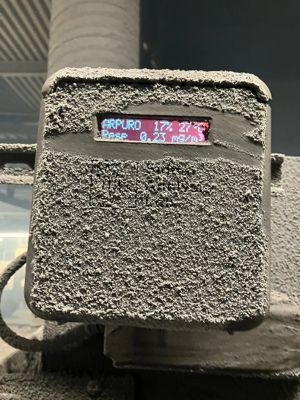
DISCLAIMER: I am representing Arpuro Labs AS, provider of mid-CAPEX (CAPital EXpenditures) sensors for indoor PM measurements, typically said to be NOK 30.000-70.000 (see Figure 2 to right). I have intentionally taken an external and neutral perspective in this blog post, including making reasonable efforts to avoid being seen as a marketing guy from Arpuro Labs. The blog post is based exclusively on publicly available information but includes anecdotal evidence, information gathered at conferences, quotes (with permission), etc. Completeness and accuracy of information cannot be guaranteed. I apologize for any errors, omissions, or misunderstandings. Opinions expressed are those of my own and do not express the views or opinions of my employer or of people quoted (except when explicitly quoted).
The NEA report, shift and directional change rel. to 2023
Let me start with (i), the NEA report: Dr. Hege Indresand, Norce was lead author. The report was focused on status quo and extensions of current measurement approaches, somewhat shallow regarding technology forecasting. However, it does mention (in sections 3.6--Ny måleteknologi under utvikling and 12--Publiserte metoder i håndtering av diffuse utslipp) microsensors (= IIoT (Industrial Internet of Things), or strictly speaking, not the same as microsensors are the sensors, IIoT are the meters/systems built with these sensors), video, and hyperspectral cameras. But, essentially 4 pages about novel technologies in a 137-page report.
In my opinion, three years after the fact, SOTA for PM monitoring has shifted both outwards and directionally, and there are significant prediction errors in the NEA report relative to SOTA 2026. Some of these prediction errors should be interpreted in context of emerging industry 4.0 technologies and transformer-based AI (see below). To be fair to Dr. Indresand (and to quote Niels Bohr, or was it Yogi Berra?), "It's tough to make predictions, especially about the future."
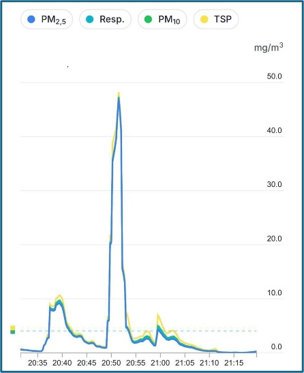
Furthermore, there was in the report limited discussion of and limited information about technologies for increased temporal and spatial coverage and resolution (see Figure 3 to the left for an example of the importance of temporal resolution; sampling: every 15 sec, typical width of dust transient: some minutes).
I have for some years discussed this coverage and resolution issue with friends at major research institutions, universities, providers of PM measurement services and heavy industry, incl. metallurgical industry, primarily in Norway. In these discussions, my friends returned repeatedly to versions of the tired old quip of being exactly wrong (and in compliance with standards) vs. being approximately right. I claim that being approximately right >> exactly wrong if we really want to solve the PM monitoring + PM mitigation measures issue.
R&D projects on diffuse emissions and PM monitoring in Norway
Then, to substantiate my claims above about issue (i), the NEA report, and to establish a basis for exploring issue (ii), the development of SOTA, I decided to do a detailed review of my involvement in various R&D project about PM / diffuse emissions in the period 2019-2026, as Head Digitalization and R&D of Nemko Norlab, provider of PM monitoring services) for measuring PM / diffuse emissions: DetecDiff (video; 2020-2026; NOK 3m in public funding), DustDetect (open-path laser; 2020-2024; NOK 10,6m in public funding), NESA (low-CAPEX + CFD (Computational Fluid Dynamics) + dispersion modelling; 2023-2027; NOK 16m in public funding), and Dig_IT (various sensors, including low-CAPEX PM sensors for underground mines; 2020- 2024; Euro 7m in public funding, of which around NOK 7m to Norwegian consortium members). This is not a complete list, and for example the project for the engineering and construction industry with Bærum Kommune and NGI in 2020 [2] is believed to have petered out without publishing costs or results.
I assess total project scope for diffuse emission and PM monitoring R&D projects in Norway in the 2019-2026 period to be NOK 100m+ and public funding to be NOK 50m+. There have in addition been a number of in-house industry projects / experimental installations, including the system at Eramet Sauda (based on a system from Aloatec, Calais, France, a software provider). So significant R&D investments and CAPEX, with public money and industry funding, and Norwegian authorities have funded quite a lot of it.
I have personally been involved in a number of these projects, as head R&D, as project manager or as technical resource, typically representing project owner or consortium member. I can confirm that school of hard knocks, and perhaps not 100% cracked the case, but in the end we have made solid progress. Kind of having partially solved the problem, and good for HSE, but less impressive from a financial perspective, or at least from supplier industry's financial perspective.
AI in diffuse emissions and PM monitoring, recent developments
And then (iii), the AI in PM monitoring issue: The NEA report, which was published in 2023, does not make any = 0 explicit references to AI or ML (Machine Learning). Alternative explanations: a) not really part of the mandate given to Norce; b) AI simply not relevant technology for PM monitoring; c) relevant, but 2023 was just after release of ChatGPT in November 2022 and before general uptake of generative AI in industry; and d) having to do with professional background of the authors. In my opinion, probably a mix of (a)-(d).
I have personally over the last two-three years been involved in a number of projects on use of AI for PM monitoring. Examples: a) ML for interpretation of video, in the DetecDiff project; b) transformer-based architectures for the same and based on some small and informal experiments using ChatGPT Plus for interpretation of video data from the DetecDiff project; and c) Arpuro Intelligence for interpretation of data from Arpuro sensors.
In all three cases (a)-(c), performance has been mixed. Regarding (a), DetecDiff with ML based on dark-channel prior and optical flow, it was at one time in the project quipped that project output consisted of gigabytes of false positives. However, subsequent improvements have led to satisfactory, though not impressive performance, at least for detection, though less so for quantification.
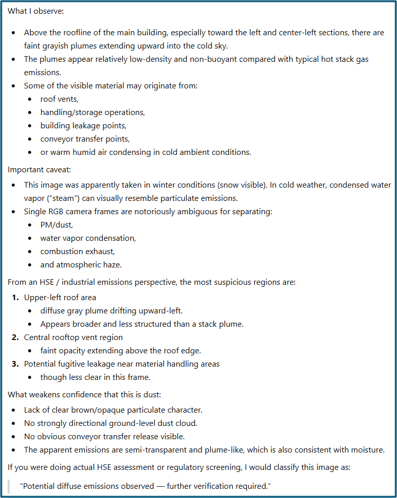
Regarding (b), transformer-based architectures = ChatGPT Plus, it was concluded that performance for qualitative characterization was acceptable or even impressive, but quantitative characterization was not. See actual output from ChatGPT for interpretation of a single frame (see Figure 4 to right).
Regarding (c): Arpuro Intelligence and sensor analytics. Key conclusion: incremental improvement = RoI amplifier rather than radical improvements. Further details on this can be found in a blog I wrote on generative AI in PM reporting-type use cases [3].
I think we can conclude that things have changed since the publication of the NEA report in 2023. Today, we would probably list AI, generative and non-generative, ML, and transformer-based, as part of the toolbox for improved PM reporting.
PM monitoring and Industry 4.0
Finally (iv), Industry 4.0: My gut feeling when starting to write this blog post was that the Industry 4.0 concept had left public discourse, especially in PM monitoring. I was wrong and this is not at all the case. Here is what Google Trends says (blue is 'industry 4.0', red is 'industry 5.0', and yellow is 'industrial internet of things'; Figure 5 below):
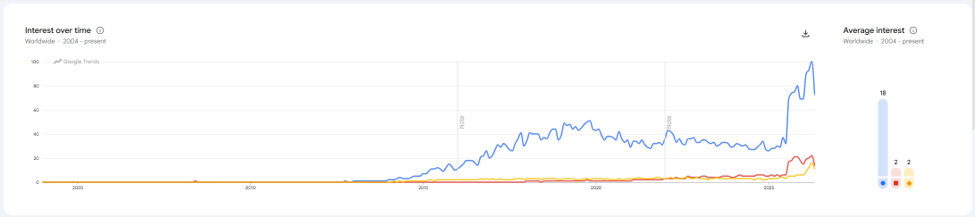
(I was right about my hypothesis that Industry 5.0 = human-centricity, sustainability, and resilience was primarily mumbo jumbo by EU bureaucrats; it never took off with real engineers. But Industry 4.0 appears to remain a solid concept.) Anyway, there is a significant interest in Industry 4.0 technologies for PM monitoring. It is just that today we call it mid-CAPEX and AI, not Industry 4.0, IIoT, and analytics.
Conclusion, by one who contributed to this work (but jointly with many friends in the Norwegian industrial community)
Based on the above analysis, I conclude as follows (focusing on the HW side of things and generally disregarding standards and SW, including AI, CFD, and dispersion models):
- Video: Video was repeatedly mentioned in the NEA report, both for flow and for concentration. Based on insights from the DetecDiff project and anecdotal evidence from Eramet Sauda / Aloatec, video seems to work OK in high-contrast situations (well-defined emission plume from pipe on blue sky), not so well in low-contrast situations (say, slow-moving and ill-defined emission plume on cloudy background). This is whether based on contrast, dark channel prior, segmentation, or optical flow.
- Open-path laser: Results were fairly good in the DustDetect project. However, looking at their website, NEO Monitors, a technology firm focused on laser-based gas measurements, has apparently decided not to commercialize its open-path laser for PM monitoring, at least not for the time being. Indeed, CAPEX is significant, and RoI is not obvious. There are, however, some open-path laser installations in Norwegian industry.
- Low-CAPEX sensors: Dr. Håkon Myklebust, in his 2021 PhD thesis, presented findings from experiments with low-CAPEX in the Norwegian metallurgical industry that attracted significant interest. Nemko Norlab endeavored from 2019-2025 to develop a business built on low-CAPEX sensors (or IIoT sensors), partly through its participation in the Dig_IT project. However, both Dr. Myklebust and Nemko Norlab learned the hard way that low-CAPEX was neither low-CAPEX nor technically easy to achieve once they began to enhance capabilities and functional footprint, including compensating for humidity and addressing fouling issues. Both Myklebust Sensordata, a tech company founded by Dr. Myklebust, and Nemko Norlab appear to have subsequently exited the low-CAPEX business.
- Mid-CAPEX sensors: Nemko Norlab (with its distribution of sensors from Sensit Technologies) and Arpuro Labs (with its Arpuro sensors) seem to be betting on mid-CAPEX sensors, with # installations per site ranging from 1 to 30. Both seem to have good traction in the market, with, for example, Arpuro Labs having tens of customers and 100+ mid-CAPEX sensors installed.
- Other technologies: LIDAR (Light Detection and Ranging) was mentioned in the NEA report. However, anecdotal evidence from the DetecDiff project indicates unsatisfactory performance in typical diffuse-emissions use cases in industry. Drones were also mentioned in the NEA report. To my (limited) knowledge, it is not in use in the Norwegian industry today for PM monitoring / diffuse emission monitoring. And then there were multi-spectral, hyper-spectral and IR. Interesting technologies, but not to my knowledge in operational use.
(I am taking a slightly broad view above, and I have glossed over some subtleties: i) dust is not dust, and indoor silica dust in metallurgical industry <> flour particles in a bakery <> what is going on at a construction site or a loading site; ii) indoor is not outdoor, say regarding typical concentrations and influence of wind, precipitation and weather conditions; iii) PM <> diffuse emissions and one may be looking for chemical composition of dust, say content of heavy metals, rather than dust itself; and iv) detection <> quantification, and concentration <> emitted mass in a time period.) But as of today: 2-3 successful technologies (mid-CAPEX and open-path laser, possibly video; ranked in order of relevance) relative to 7 technologies explored. 2-3 out of 7 would be considered a pretty high success rate in deep tech, no? And this is not the end of our journey.
In sum, a mixed picture. That said, in my opinion, it would be wrong to disregard learnings from and a clear SOTA shift in the 2019-2026 period in the metallurgical industry, supplier industry, technology firms, and academia about the societal benefits of using continuous time sensors for diffuse emission monitoring. It could be argued that mostly all stakeholders would benefit from giving industry more leeway to use modern sensor technology as a replacement for gravimetric measurements in industry's reporting to the authorities. Direct benefits: better spatial and temporal resolution and coverage. Indirect benefits: good for occupational health, good for CAPEX optimization, and good for process improvements.
Some weeks ago, I had a chat with Dr. Indresand, the author of the NEA report as referred to above, about my findings above. Her comments, slightly abridged (received by email in a follow up and with her permission to publish in this blog post): "Grim, thanks for reading the report and discussing it when you dive into this topic. I appreciate that you could see the report for what it was. Four pages of future thoughts versus what has happened until now in the midst of large industry characterization and permitting processes on diffuse emissions... the project of writing it was extremely difficult to say the least. However, the importance of documenting history and current practice and more importantly, the dialogue and mutual understanding that was achieved between industry, scientists, and the NEA was I think a necessary collective step to set the stage for the future. With everything that has happened since in AI, modeling, and sensors, we were able to finally see the steps and actual research gaps to get there. The immediate answer to me was, we need complete and long-term data sets to work with dynamically to deliver working solutions now! Systems that can give end users everything they need in their daily operations, real-time overview, benchmarking, reporting, and predictions. In this aspect, accurate sensors are indeed still important. We are tackling this challenge for industry dust in our new proposed project LESS DIFFUSE together with you guys in Arpuro Labs and other industry partners."
And going back to my May 17 conversation partner referred to above, the engineer friend-of-friend-of-friend Petter, would he concur with the above conclusions? I think so, very much. Petter is an ex-representative of major engineering firms and technology suppliers in this space, with extensive practical experience from dust issues in industry (plus a master's degree in mechanical engineering), and I am pretty sure that he would find sensor-based solutions like Arpuro more useful than gravimetric offerings for most of his type of work, except for when time-averaged results in compliance with applicable standards, say EN 12341, is really the required deliverable.
As an afterthought, after having revisited my findings and reflections on the measurement of PM and diffuse emissions above, it became clear that I owe my ex-colleagues at my former place of work (a major provider of gravimetric PM measurement services in Norway) a sincere apology. Yes, I was perhaps wrong when I criticized them at one point for being "on the wrong side of history." Yes, gravimetric measurements of PM will continue to play a significant role, especially for accurate, standards-based reporting to authorities. The short story: gravimetry is good for accuracy and compliance; mid-CAPEX, open-path laser, and video are good for temporal and spatial coverage/resolution (and costs and engineering insights).
Acknowledgements
Thanks first to Petter, who really kicked this discussion off. Thanks also to Dr. Indresand; partners and colleagues in industry; friends and collaborators in various parts of SINTEF, the research organization; and colleagues at Arpuro Labs who for over some years having helped me sharpen my thinking about the development of SOTA for PM measurements 2019-2026 and for directly or indirectly having encouraged me to write this long-read.
Grim
*) The reader may wonder about the choice of period. Explanation: I got involved in monitoring diffuse emissions and PM in 2019 as a new employee of Nemko Norlab, leading provider of gravimetric measurement services to Norwegian metallurgical industry, and tasked with building up capabilities in industry 4.0 technologies. But the industry's interest in diffuse emissions predates of course 2019, and the NEA report mentions explicitly the FUME project from 2009-2015 by major research organizations and major industry.
References
[1] Indresand, Hege; and Skistad, Håkon. 2023. Kartlegging av diffuse utslipp til luft fra industri. Norce. In Norwegian. Available: https://www.eydecluster.com/media/26769/diffuse-utslipp-rapport.pdf
[2] NGI. 2020. NGI vant innovasjonsprosjekt for døgnkontinuerlig miljøovervåking av anleggsprosjekter. In Norwegian. Available: https://kommunikasjon.ntb.no/pressemelding/17892793/ngi-vant-innovasjonsprosjekt-for-dognkontinuerlig-miljoovervaking-av-anleggsprosjekter
[3] Gjønnes, Grim. 2026. The quest for tangible RoI from the use of generative AI for interpreting dust sensor data in metallurgical industry. Crisp Ideas. Available: https://crispideas.wordpress.com/2026/04/03/the-quest-for-tangible-roi-from-the-use-of-generative-ai-for-interpreting-dust-sensor-data-in-metallurgical-industry/